
Aging Out of Foster Care: Options for A Young Adult Transitioning to Adulthood
Contributed by Speak Up for Kids Student Intern Team — This article was developed through the combined efforts of multiple student interns, each bringing unique skills and perspectives to support life skills education for foster youth.

Overview
When you turn 18, you ‘age out’ of foster care, and that can be exciting and scary all at the same time. Please know, you are not left on your own, and there are people and resources available to help you in this process. This page will share some of the choices and resources that are available to you to help you transition to independent living and adult life.
Extended Foster Care (EFC)

EFC is a program that can allow you to remain in foster care until you are 21.
Eligibility Requirements for EFC:
- You aged out in the legal custody of DCF
AND
- You are participating in a qualifying activity like;
- Attending high school or working on GED; or
- Enrolled in college or vocational education program; or
- Employed at least 80 hours per month; or
- Participating in a program designed to promote or eliminate barriers to employment; or
- Have a diagnosed and documented disability that would prevent you from participating in any of the activities listed above.
In order to stay in the program, you must continue to meet the eligibility requirements above, meet with a caseworker each each month, and go to a court review every six months.
If you leave EFC, but then want to re-enter, you are able to do so if you still meet the eligibility requirements. You will need to re-apply, but this is a possibility.
Check out this article with more details on the Extended Foster Care option.
Postsecondary Education Services and Support (PESS)
Eligibility Requirements for PESS:
- You turned 18 while in the legal custody of the Department and who you have spent a total of at least six months in licensed out-of-home care before turning 18
OR
- You are at least 18 and you were adopted after the age of 16 from foster care or placed with a court-approved dependency guardian after spending at least 6 months in licensed care within the 12 months immediately preceding such your placement or adoption
AND
- You have earned a standard high school diploma, or its equivalent
AND
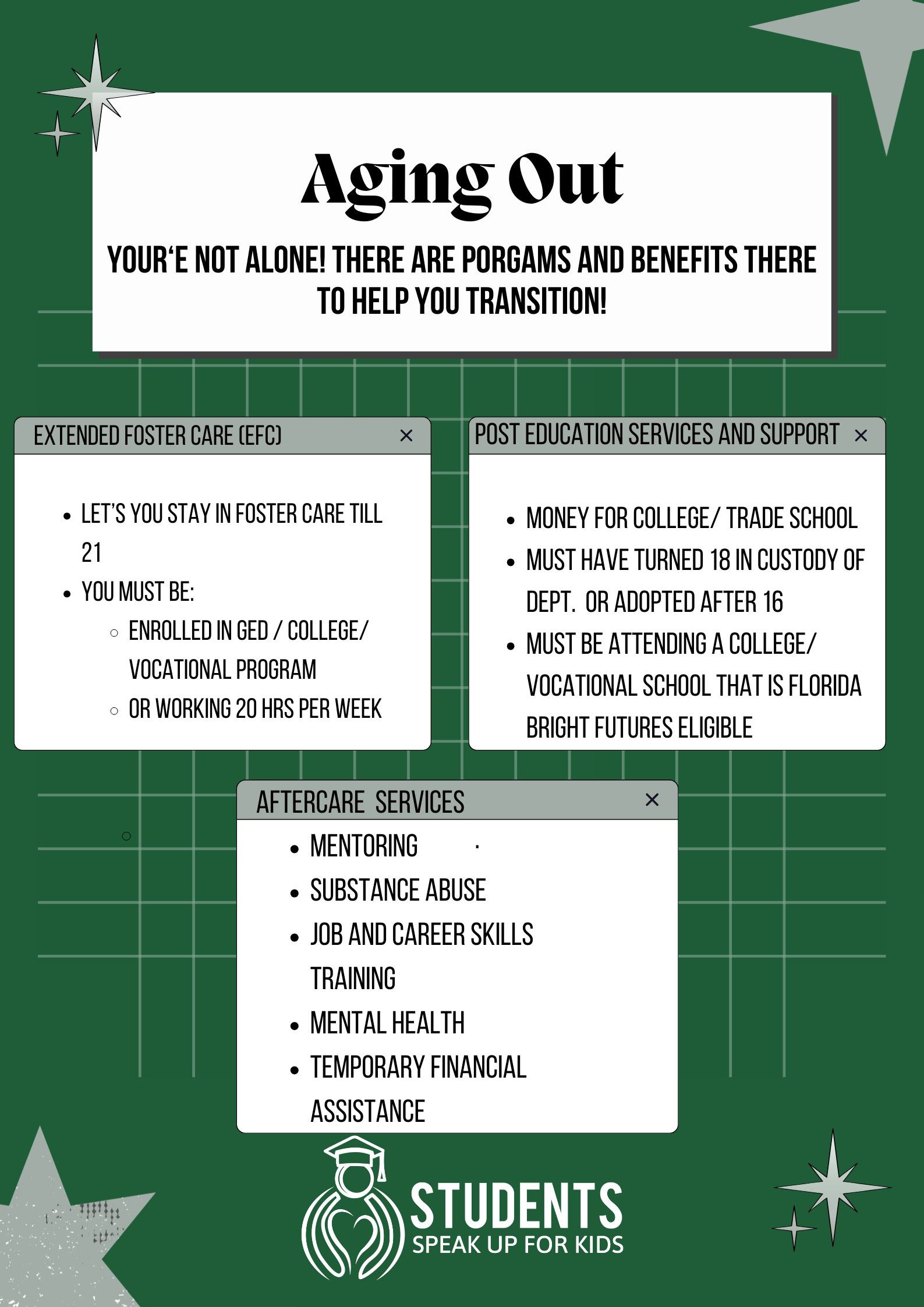
- You are attending a college or vocational school that is Florida Bright Futures eligible.
- If the school you are attending is NOT a Florida Bright Futures-eligible School, you are NOT eligible for PESS; however, you may be eligible to receive ETV funding. ETV is a federal grant provided to states to help fund eligible former foster youth who are enrolled in postsecondary programs. There are specific eligibility requirements for funding and states have some discretion to limit or expand eligibility. Florida has determined that funding may be provided to youth who have reached 18 years of age but are not yet 23 years of age. The initial application for these funds must be received before the young adult’s 21st birthday. ETV grant funds are limited; therefore, financial assistance will be administered on a first come, first served basis.
- This program is available until you reach your 23rd birthday.
- Check out our article with more details on the PESS program.
Aftercare Services
Aftercare services are a program that you can participate in if you are not involved in EFC or PESS. It is often seen as something that you can participate in while you are applying for EFC or PESS, but before you actually enter those programs.
Services may include:
Mentoring and counseling.
Tutoring.
Mental health and substance abuse.
Parenting.
Job and career skills training.
Temporary financial assistance for necessities.
See this article for more information on Aftercare and Transitioning out of Foster Care.
Helpful Resources
Here are some of the places where you can connect to resources and find support throughout this process:
Daniel IL Florida Resource Center
This page provides information and links to resources that they have collected to help you as you transition to independent living.
Hope Florida can help you get connected with someone who can work with you to identify the goals that you have and what barriers are in the way. They can also connect you with someone who can help you find resources that are local.
Final Thoughts
Aging out of foster care is a major life transition, and it’s normal to feel both excited and uncertain about what comes next. Programs like Extended Foster Care, PESS, and Aftercare exist to support you as you move toward independence, education, and stability. By learning about your options and reaching out for help when you need it, you can take confident steps into adulthood knowing you don’t have to do it alone.