
AI Scams: How to Recognize and Avoid Them
Contributed by Aditi Amin — Speak Up for Kids Student Intern, a sophomore at Fulton Science Academy, passionate about artificial intelligence, cybersecurity, mental health advocacy, and using technology to create meaningful change.
Overview
Artificial intelligence (AI) is changing the way we communicate, work, learn, and use the internet. While AI can be a useful tool, scammers are also using it to make scams more convincing.
Scammers can use AI to create realistic voices, images, videos, messages, websites, and more. This can make it harder to tell whether something online is real. For young adults preparing for independence, knowing how to recognize and respond to scams is an important life skill.
The good news? You don't need to be an AI expert to protect yourself. You just need to know what warning signs to look for and how to verify information before acting.
What Is an AI Scam?
An AI scam is a scam that uses artificial intelligence to make content or interactions appear more believable.
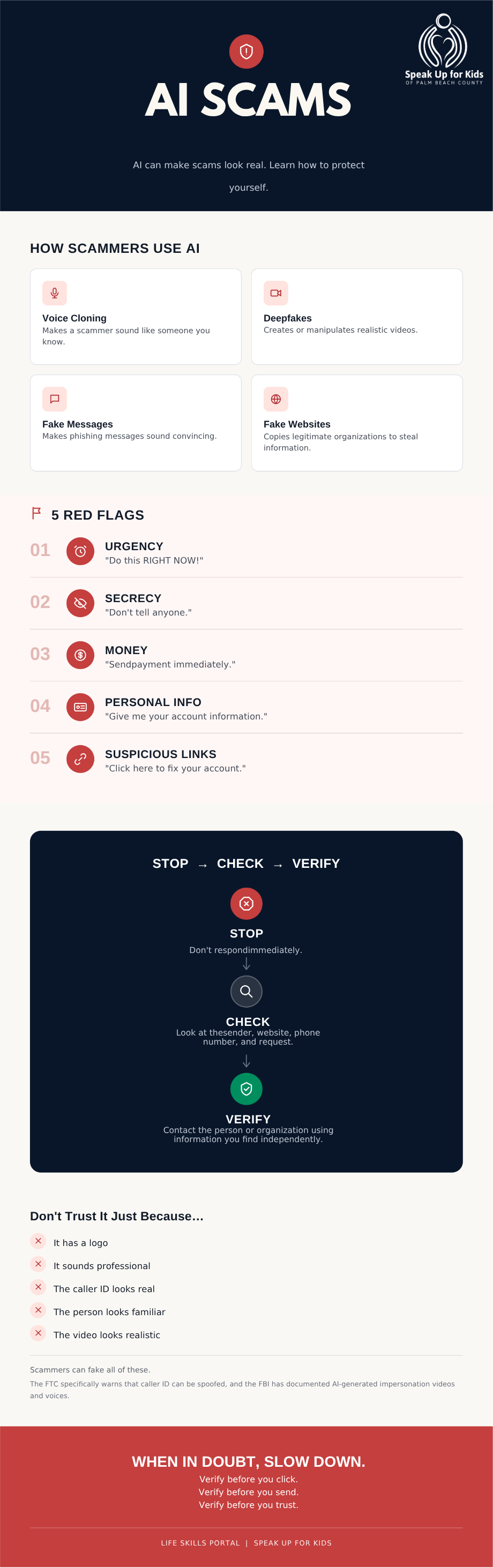
For example, a scammer might use AI to:
Clone someone's voice
Create or manipulate a video
Write a convincing text or email
Create a fake social media profile
Build a fake website
Personalize a scam using information found online
AI doesn't necessarily create an entirely new type of scam. Instead, it can make traditional scams more convincing and easier to personalize.
That's why one of the most important rules to remember is:
Just because something looks or sounds real doesn't mean it is.
Common AI Scams to Watch For
Voice Cloning Scams
Imagine receiving a phone call from someone who sounds exactly like a family member or friend. They tell you they're in trouble and urgently need money.
A scammer may be using AI voice cloning technology to imitate that person's voice. The Federal Trade Commission (FTC) warns that scammers can use short audio clips found online to create convincing voice clones.
How to Protect Yourself
If someone unexpectedly calls asking for money or sensitive information:
Stop and verify.
Contact the person through a phone number or communication method you already know belongs to them. Don't rely solely on the number or contact information provided by the caller.
Deepfakes and Fake Video Calls
AI can also create or manipulate videos.
A scammer could use a fake or altered video to impersonate:
A family member
An employer
A company representative
A government official
Another person you recognize
The FBI has warned about scammers using AI generated videos and other media to impersonate real people.
Remember: Seeing someone on a screen doesn't automatically prove who they are.
If they ask you to send money, share sensitive information, or take an unusual action, verify their identity through another trusted method.
AI-Generated Phishing Messages
Phishing is a scam designed to trick you into clicking a link, opening an attachment, or giving away personal information.
In the past, phishing messages were sometimes easy to recognize because they contained obvious spelling or grammar mistakes. AI can make fraudulent messages sound much more professional.
For example, you might receive: “We've detected unusual activity on your account. Please click the link below to verify your information.”
Instead of immediately clicking, stop and ask yourself:
Was I expecting this message?
Do I recognize the sender?
Does the link lead to the organization's real website?
Can I contact the organization directly?
The FTC recommends independently contacting an organization using a phone number, website, or other contact information you know is legitimate rather than using information provided in a suspicious message.
Fake Job Opportunities
Looking for your first job or a new opportunity? Be careful with unexpected offers.
Scammers can use AI to create convincing job descriptions, recruiter profiles, emails, and other materials.
Be especially cautious if someone:
Offers you a job without a normal application or interview process
Promises unusually high pay for very little work
Asks you to pay money to get started
Requests sensitive personal information immediately
Pressures you to make a decision quickly
Communicates only through unusual or unverified accounts
A professional-looking job offer can still be fake.
Before accepting an opportunity, research the company independently and verify that the position actually exists.
Fake Websites and Social Media Accounts
Scammers can create websites and social media accounts that imitate legitimate organizations.
A fake website might use:
A familiar logo
Similar colors and designs
Professional-looking language
A website address that looks almost correct
Before entering personal information, carefully check where you are.
Ask yourself:
Is this the organization's official website?
Did I navigate here myself, or did someone send me the link?
Does the website address look correct?
When in doubt, leave the page and find the organization's official website independently.
7 Red Flags of an AI Scam
AI can make scams more believable, but many scammers still rely on familiar warning signs.
URGENCY
“You need to do this right now.” Scammers may rush you so you don't have time to think.
SECRECY
“Don't tell anyone.” A request to keep a financial or personal situation secret can be a major warning sign.
UNEXPECTED MONEY REQUESTS
Someone suddenly asks you to send money or purchase something.
REQUESTS FOR PERSONAL INFORMATION
Someone asks for sensitive information without a clear reason.
UNEXPECTED LINKS
You receive a link you weren't expecting and are told to click it immediately.
FEAR OR PRESSURE
Someone threatens that something bad will happen if you don't respond.
SOMETHING SEEMS TOO GOOD TO BE TRUE
You are promised easy money, a guaranteed opportunity, or a prize you don't remember entering.
These warning signs aren't limited to AI scams. However, AI can make these tactics more convincing.
Don't Try to “Spot AI”; Verify Instead
You may see advice online about looking for blurry images, strange hands, unnatural voices, or other clues that something was AI generated.
Those clues can sometimes help, but they aren't foolproof.
AI-generated content can be difficult to identify reliably, which is why the FBI recommends focusing on verification rather than simply trying to determine whether something looks AI-generated.
Instead of asking:
“Does this look like AI?”
Ask:
“Can I independently confirm that this person, message, or request is legitimate?”
That's a much safer approach.
Protect Your Personal Information
One of the easiest ways to protect yourself from scams is to be careful about what information you share online.
Never share sensitive information simply because someone asks for it.
Be cautious with:
Social Security numbers
Passwords
Bank account information
Credit or debit card information
Security codes
Private documents
Account login information
You should also think carefully before entering personal information into AI tools. If you wouldn't post it publicly, think twice before putting it into an AI tool.
What If You Already Fell for a Scam?
If you clicked a suspicious link, shared personal information, sent money, or think someone has accessed one of your accounts, don't panic and don't hide it.
Tell a trusted adult or another person who can help you as soon as possible.
Depending on what happened, you may need to:
Change compromised passwords
Secure your accounts
Contact your bank or financial institution
Report the scam
Monitor your accounts for suspicious activity
The FTC provides guidance for people who have been scammed, and internet related crimes can be reported to the FBI's Internet Crime Complaint Center.
Getting help quickly can make a difference.
AI Scam Safety Checklist
Before responding to a suspicious message, call, video, or website, ask:
Was I expecting this?
Is someone pressuring me to act immediately?
Are they asking for money?
Are they requesting sensitive information?
Did they send me an unexpected link?
Can I verify this through an official source?
Have I talked to someone I trust?
If you answered “yes” to several of these questions, stop and verify before doing anything else.
Final Thoughts
AI is making scams more sophisticated, but you don't need to be an expert in technology to protect yourself.
Most importantly, remember:
AI can make a scam look real. Verification helps you know whether it actually is.
Being able to recognize scams and protect your personal information is an important part of becoming independent!