

Cards to Know
Contributed by Speak Up for Kids Student Intern Team — This article was developed through the combined efforts of multiple student interns, each bringing unique skills and perspectives to support life skills education for foster youth.
Overview
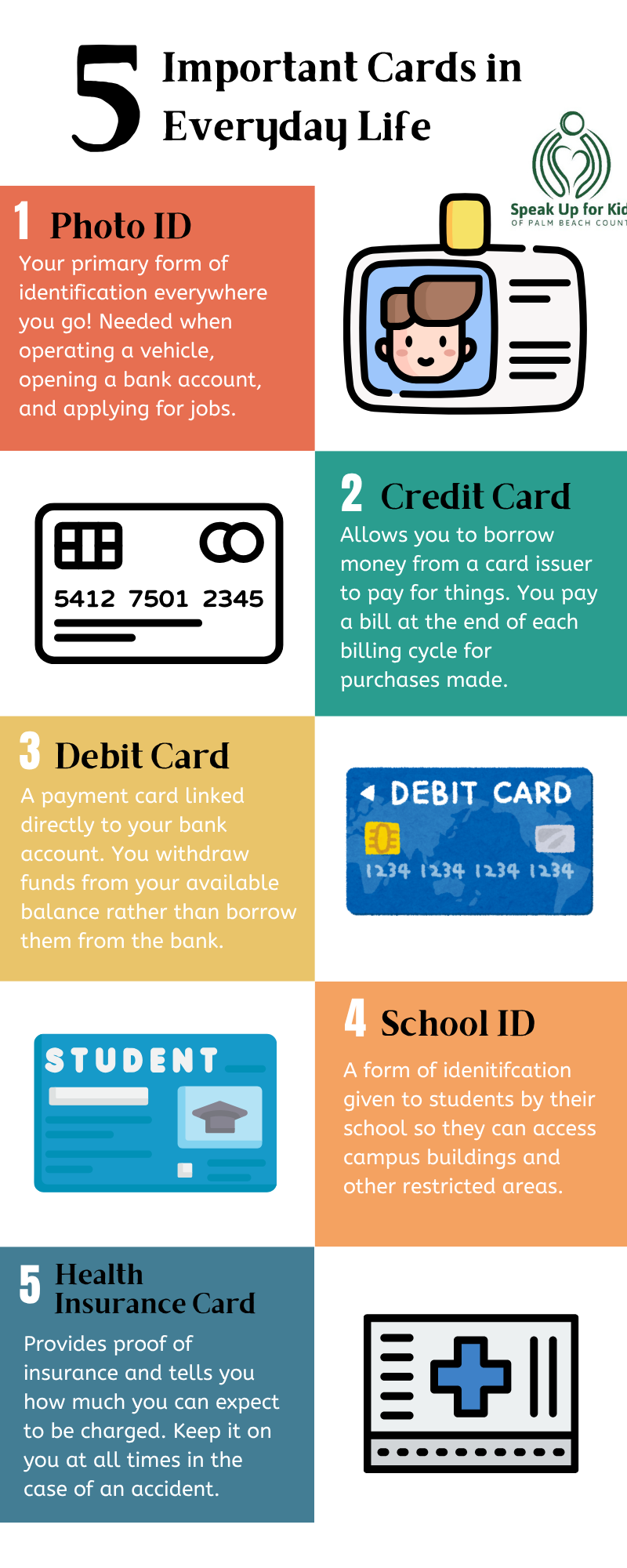
There are many different types of cards young adults have at their disposal. Let’s take a look at five of the more common ones and their ins and outs.
Social Security
Your Social Security Card is one of the most important cards you’ll have in life. Let’s take a look at what it is, how it’s used, and some best practices:
Issued by the Social Security Administration (SSA) - An important organization that distributes the card to individuals
Various Uses - From employment to finances and beyond
Keep it in a Secure Location - Protect the card to prevent identity theft
What is It?
The primary purpose of a Social Security Card is to act as a physical representation of someone’s Social Security Number (SSN), a nine-digit number formatted like 021-05-2003.
They’re usually issued at birth, but only when the SSA has all the required information and documents.
What is It Used For?
Many employers need your Social Security Card so that they can report your wages to the government.
Banks will often ask for your Social Security Card if you want to open up an account with them, although it isn’t always required.
Your Social Security Number is used by the Internal Revenue Service (IRS) to identify you as a taxpayer and to process your tax returns.
Your Social Security Card is also used to receive government services and as a way to collect things like retirement and disability benefits.
Best Practices
Because your Social Security Number is the most important part of the card, it’s best to memorize your number and keep the card in a secure location instead of your wallet where most other cards will go.
If your Social Security card gets stolen, you risk subjecting yourself to identity theft. Because the card is used for things like opening credit accounts and determining tax returns, if someone gets their hands on your card, they can commit financial crimes under your name, which can be difficult to rectify.
Additionally, the crimes identity thieves commit can negatively impact your credit score, cause you debt, and involve a strenuous process of fixing them.
Credit Cards
A Credit Card is something that you’ll use often, so let’s take a look at what it offers you:
Borrowed Money - A bank lends you money so you can make purchases
For Everyday Spending - Things like groceries, gas, etc.
Always Make Payments - Try to avoid making late payments and pay more than the minimum
What is It?
When you use a Credit Card, you’re essentially borrowing money from the bank in order to make a purchase, which you then have to pay back later, often referred to as “paying off your card.”
With each purchase, the balance on your card increases, and at the end of the month you’ll receive a statement that lists all of your purchases for that timeframe, any fees or interest to be paid, and the minimum amount of money you have to pay.
If you pay the whole balance on the card, you can avoid paying interest on your previous purchases. If you pay the minimum, whatever balance is left carries over to the next month, and you’ll have to pay interest, which is a percentage of extra money you owe on top of the cost of your unpaid purchases.
What is It Used For?
Credit Cards are great for everyday expenses, such as groceries, gas, eating out, and similar types of goods and services.
One of the main benefits of using a Credit Card is to build good credit. If you make payments on time, it shows that you can be trusted with being lent money. This is represented by your Credit Score, which is a number that ranges from 300 (poor) to 850 (very good). The better your Credit Score, the more likely you are to be eligible for big purchases like getting a mortgage or taking out a student loan.
Credit Cards also reduce the need to carry around cash, which can be cumbersome and dangerous if you’re keeping a lot on you.
Best Practices
Be intentional about making payments on time, as it directly influences the quality of your Credit Score. Try your best to avoid accumulating interest, as it only makes you pay more money in the future.
Practice temperance. It’s easy to swipe and forget about purchases until the bill comes due. Make sure you’re not recklessly spending more than you have the ability to pay for!
It’s also important to protect your card. Make sure you have it when you walk out of places where you just used it, and always review your statement for any discrepancies that could indicate a fraudulent purchase.
Debit Cards
Debit Cards are similar to a Credit Card but have some key differences:
Direct Connection to Bank Account - Deducts money directly from your account
ATMs - Withdraw cash and check your account balance
Protect the Card - Getting your Debit Card compromised is usually considered to be worse than your Credit Card being compromised
What is It?
Unlike a Credit Card where you’re lent money to make purchases, a Debit Card immediately withdraws money from a bank account when you make a purchase.
Debit Cards are most commonly linked to a checking or savings account.
Debit Cards also don’t have a limit on how much you can spend at one time like a Credit Card, as the number is equal to the amount of money in the account the card is linked to.
What is It Used For?
Debit Cards are commonly used to withdraw cash from ATMs. You can also check the balance of your account at an ATM.
Debit Cards can also be used for everyday purchases like a Credit Card, although it’s generally considered to be less safe than using a Credit Card.
Best Practices
Because Debit Cards withdraw money directly from your account, if yours gets compromised, someone can more easily steal your money than with a Credit Card. Be mindful of where you’re using your Debit Card to minimize the risk of having its information stolen.
Just like with a Credit Card, check the account your Debit Card is linked to regularly so that you can quickly detect any fraudulent purchases.
If your card is lost, stolen, or compromised, make sure you know how to lock the card so it can’t be used and notify your banking agency as soon as possible.
College ID
A College ID is something that can greatly enhance your experience with higher education; let’s see how:
Proof of Enrollment - Shows that you’re a registered student at a given institution
Access Services - These cards entitle you to use various resources on campus
Take Advantage - Research what benefits are open to you
What is It?
A College ID acts as a place to store a student’s personal information so that it can be scanned or have the number read for the college to quickly access that information.
College IDs typically have an ID number that is specific to that student. They also might include a picture of the student.
What is It Used For?
The main way College IDs are used is as a way of proving that a student is actually enrolled in an institution. This helps the university verify that you’re eligible to take advantage of resources like recreation and learning facilities like gyms or libraries.
College IDs are commonly used as a way for students to pay for services on campus, such as dining areas or laundry rooms.
Institutions will also use the card as a way of keeping track of a student’s records.
Best Practices
If your College ID requires a photo, make sure that picture is clear and current.
Like with many of the other cards we’ve discussed, make sure to report it if it gets lost or stolen.
Spend some time researching what exactly your College ID can do for you. Find out what resources it opens up and where to take advantage of them.
Driver’s License
A Driver’s License is a simple yet important card for you to know about:
Legal Permission to Drive - Shows that you’re able to drive
Form of Identification - It proves that you are who you say you are
Keep it on You - Misplacing it can cause problems, from minor inconveniences to actual crimes
What is It?
A Driver’s License certifies that you can drive and acts as proof that you are competent enough to do so.
It also serves as a form of identification with information such as your address, date of birth, and a picture.
What is It Used For?
Beyond showing that you’re eligible to drive, the main use of a Driver’s License is to verify your identity in various situations, like when you apply for a job, purchase alcohol when you’re old enough, or try to open a bank account.
Best Practices
Always keep your Driver’s License on you. Because it is so widely used as a means of verifying identity, you never know when you might need it! Whether you’ve been pulled over or are trying to open a bank account,
Driving without a license is a crime that can result in fines and the offense going on your record, so always double-check that you have it on you.
Final Thoughts
A Social Security Card is issued by the Social Security Administration and acts as a physical representation of your Social Security Number. This card is used to report wages, open up bank accounts, and to process your tax returns, among other things. Because this card is so important, keep it in a secure location because if it gets stolen, someone could steal your identity and cause you problems that are difficult to fix.
A Credit Card is used to borrow money from a bank in order to make everyday purchases, like groceries or gas. The money must be paid back later, so make sure to always make payments on time and pay more than the minimum to avoid paying excess fees and interest.
A Debit Card withdraws money directly from your bank account and can also be used to withdraw money from ATMs. Because it takes money straight from your account, it isn’t as common to use it for everyday spending because if it gets compromised, someone can more easily steal your money than with a Credit Card.
A College ID serves as proof of enrollment for an academic institution and allows students to take advantage of various resources the school offers, such as libraries, gyms, and dining areas.
A Driver’s License is one of the most commonly used forms of identification and also shows that you’re able to legally drive. Make sure to always keep it on you and don’t drive without it!
With any of these cards, make sure that if they get lost or stolen to report it as soon as possible. People with nefarious intent can use these cards to steal your identity and your money, so remain knowledgeable about where they are and their current status.