

Looking for Family After Foster Care: How to Find a Parent in Jail, ICE Detention, or After Deportation
Contributed by Rubenia "Ruby" Salgado — Speak Up for Kids Student Intern, a psychology student at Southern New Hampshire University, passionate about advocating for foster youth, strengthening Hispanic families through education, and empowering others with practical life skills.
OVERVIEW
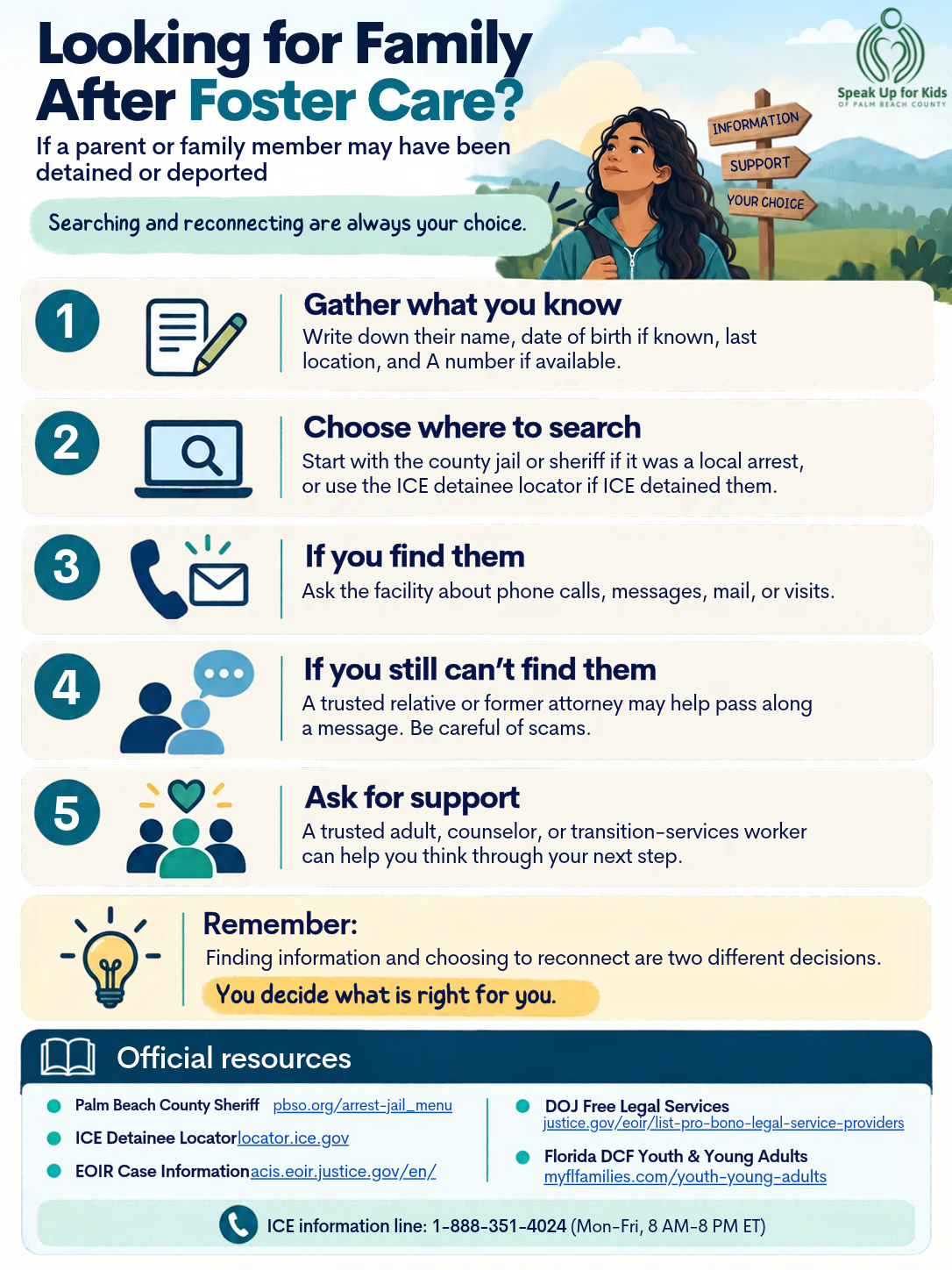
Maybe you lost contact with a parent or relative while you were in foster care. Maybe you heard they were arrested, detained by ICE, or deported, but you do not know what happened. If you are leaving or have left foster care, this guide can help you decide where to look.
You do not have to search for anyone or reconnect with them. You can look for information without making contact, and you can stop at any point. If a person hurt you or made you feel unsafe, your safety comes first.
STEPS
1. Start with what you already know
Write down what you know: their full name (including other names they may use), country of birth, date of birth if known, last known location, and immigration A-number if available. An A-number is an identification number on some immigration documents. You do not need every detail to begin.
If you feel comfortable, ask a trusted relative or family contact whether they know anything. Do not post private documents, Social Security numbers, or other sensitive information online. If you have access to your own foster care records, they may contain names or contact information that could help you begin your search.
2. Choose where to search
If you think they were arrested locally: Check the official county jail or sheriff’s office. In Palm Beach County, visit the Palm Beach County Sheriff’s Office arrest and jail page or call Inmate Records at 561-688-4340. The jail can check booking information for its facilities. A public court record may show a legal case, but it is not proof of where someone is being held now.
If you think ICE detained them: Open the ICE Online Detainee Locator. Search with an A-number and country of birth, or the exact first and last names and country of birth. A date of birth may help with a name search. Check spelling carefully. The locator has limits and does not include everyone. A missing result does not mean the person was never detained; they could be in another agency’s custody or their record may not be available yet.
If you cannot find a result, you can contact the ICE Detention Reporting and Information Line at 1-888-351-4024. Live operators are available Monday through Friday, 8 AM–8 PM Eastern Time, excluding holidays. Language assistance is available. Ask which office or facility to check next. A person may be transferred to a detention center outside Florida.
If you know their A-number and want to check a possible immigration court case, use the EOIR immigration court case information system. It shows basic information about certain cases, not where someone currently lives or is detained.
3. If you find them, decide whether to make contact
You get to decide whether to reach out. If they are in a Palm Beach County jail, the Sheriff’s Office telephone information explains that people in custody cannot receive incoming phone calls, but may make outgoing calls. It also describes how a family member can set up a Securus phone account. There may be charges, so check costs first.
For a video visit at a Palm Beach County jail, review the PBSO visitation rules and locations and use the PBSO video visitation registration page. The sheriff lists video visitation centers in West Palm Beach and Belle Glade. Do not assume a visit can be completed from home without confirming.
If they are in ICE custody, start at the official ICE detention facility directory. Find the exact facility and read or ask about its current phone, mail, message, and visiting rules. Facilities may have different systems and fees. A video service offered for attorneys is not necessarily available to family members.
You could ask: “How can I send a message or arrange a call with someone held there? What information, identification, or fees do I need?” Some communications are monitored or recorded. Contact may not be available immediately or guaranteed.
4. What if they were deported, or you still cannot find them?
The ICE detainee locator does not identify where someone lives after deportation. If you choose, a trusted relative may be able to pass along a message. An attorney previously working with your family may sometimes pass along a message, but confidentiality rules can limit what that office can tell you.
Be careful of anyone asking for money while promising they can find the person or fix their immigration case. For immigration legal advice, seek a licensed attorney or an authorized, accredited representative at a recognized organization. If you need legal advice about an immigration case, the U.S. Department of Justice list of free legal-service providers includes organizations and attorneys offering free legal services for certain immigration court matters. Providers may have eligibility requirements and may not help locate family members. They may also be unable to accept new cases.
5. You can ask for support
You do not have to do this by yourself. A trusted adult, counselor, or transition-services worker may help you think through your choices. Some young adults in Florida can receive case-management support through Extended Foster Care after age 18 if eligible. See Florida DCF’s youth and young adult resources.
FINAL THOUGHTS
You may find answers quickly, slowly, or not at all. Finding information and building a relationship are different choices. You are allowed to decide what is right for you.
Edited by MC