

What You Should Know As A Citizen Aging Out of Foster Care: Know Your Bill of Rights
Contributed by Estella Lavrik — Speak Up for Kids Student Intern, a Jupiter High School student involved in student government and Music Buddies, who enjoys math, science, writing, and art, with a focus on building professional skills for her future career.
Overview
While the United States Constitution now houses a total of 27 written amendments, the Bill of Rights lists only the first 10 amendments that were added in 1791, three years after the Constitution was ratified. The Bill of Rights initially served as a compromise to appease worried Anti-Federalists (people against the ratification, or approval, of the Constitution) who wanted to ensure their rights would still be protected under the stronger government being established.
This may seem like a lot of information to process at once. (And that only covers the tip of the iceberg of the history behind the Bill of Rights!) Don’t worry, this article is not a full-on history lesson. It covers just what you should know as a citizen: the basics of the protections the first 10 amendments provide and how they actively apply to your own life.
First Amendment
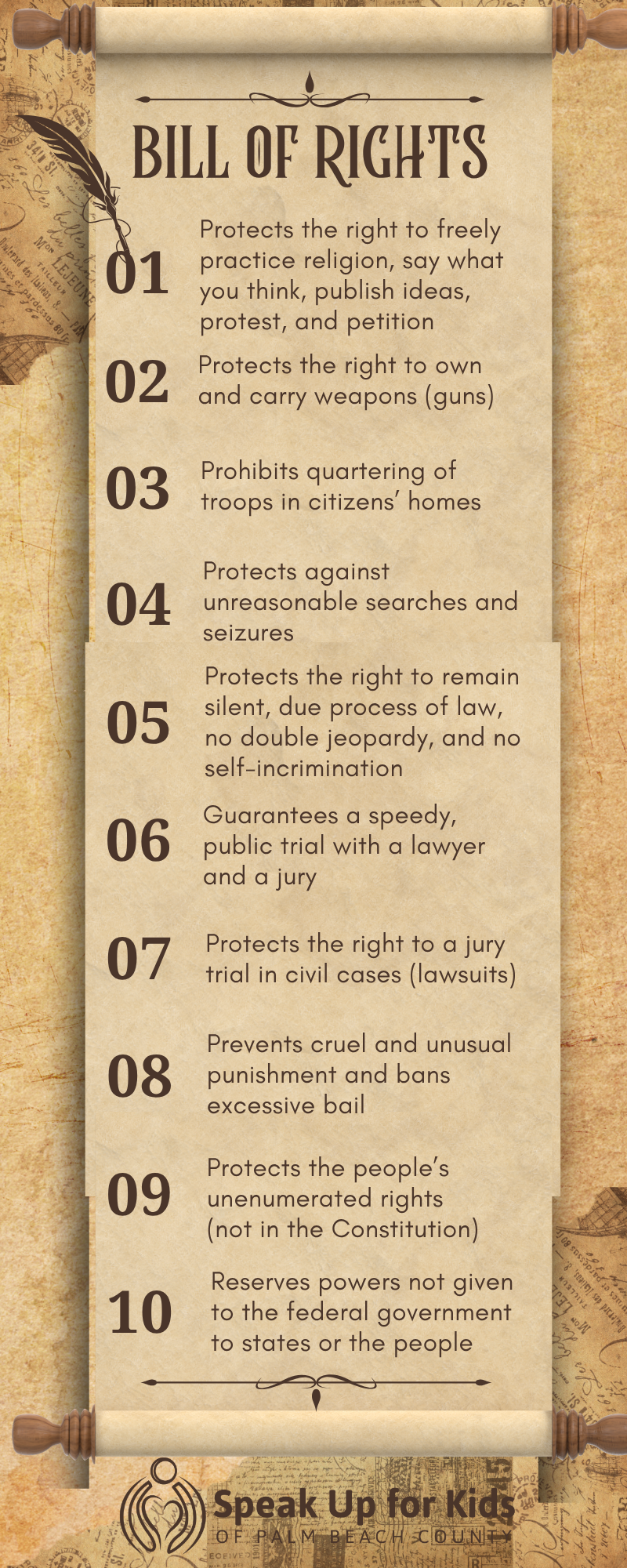
This amendment protects your right to freely practice religion (or not practice it at all), speak how you feel, publish ideas in the press, protest, and petition the government for change. Sounds great? Sure, but not all speech is protected; the Constitution doesn’t protect speech that causes direct harm or that provokes illegal action.
Second Amendment
This amendment protects your right to own and carry Arms (weapons) for your own self-defense. It is often used as the basis of debates around gun control. This right is not unlimited, as there are restrictions on who can own guns, where they can carry them, the types of allowed weapons, and how they’re carried.
Third Amendment
This amendment prevents the government from forcibly housing soldiers in citizens’ homes during peacetime. Seems weird to you? That’s because this amendment was relevant during the time of the American Revolution, when the British would quarter troops in houses against the public’s interest.
Fourth Amendment
This amendment protects against unreasonable searches and arrests. Police need a warrant based on probable cause to conduct a search unless a specific exception applies. Exceptions may include situations where people are in immediate danger or if objects being searched are in plain view.
Fifth Amendment
This amendment protects people in criminal cases, which involve the government prosecuting someone for breaking a law. It includes the right to remain silent and the protection of due process of law (fairness in legal matters). It also protects against forced self-incrimination and against double jeopardy, or trying a person for the same crime twice.
Sixth Amendment
This amendment applies only to criminal cases. It guarantees a speedy, public trial. It also includes the right to a jury trial, to have a lawyer, and to question witnesses.
Seventh Amendment
This amendment, unlike the Fifth Amendment, concerns civil cases, or cases involving a dispute between people or organizations seeking money. This amendment protects the right to a jury trial in these cases.
Eighth Amendment
This amendment prevents cruel and unusual punishment. It also bans excessive fines and excessive bail. Bail is the temporary release of someone accused of a crime, secured by a financial payment that is returned to the prisoner if they show up later for a trial.
Ninth Amendment
This amendment protects your unenumerated rights, or any rights not specifically listed in the Constitution. So, just because certain rights are included in the Constitution doesn’t mean that other rights granted to the people are denied. An example of an unenumerated right is privacy.
Tenth Amendment
This amendment reserves powers not given to the federal (central) government to the states or the people. This amendment prevents the federal government from being too powerful, allowing states or citizens hold all other authority besides the government’s enumerated powers.
Final Thoughts
Now you’re well-versed in the first 10 amendments of the Constitution! The other 17 amendments were ratified irregularly after the Bill of Rights was adopted, spanning from 1795 to the ratification of the 27th Amendment in 1992.
Knowing the Bill of Rights is important to you so you not only can become a well-informed citizen, but you can also identify when your guaranteed rights are being violated.
If, after all this, some rights still appear confusing to you, there are countless resources available online to help jog your memory. Don’t know where to start, or get bored easily? Check out this fun constitutional rights game: Do I Have a Right?