

Know Your Government As you Transition to Adulthood: The Three Branches of Government
Contributed by Estella Lavrik — Speak Up for Kids Student Intern, a Jupiter High School student involved in student government and Music Buddies, who enjoys math, science, writing, and art, with a focus on building professional skills for her future career.
Overview
The United States government can appear pretty complicated at first. However, it was not always this way. Before our government was established in the Constitution, there stood a simpler government with its rules outlined in a document known as the Articles of Confederation. This government only had one “branch” of power comparable to our legislative branch. (Don’t worry, you’ll know what that means soon enough!)
Naturally, this government was not effective, as it had the power to write laws but no power to enforce them on citizens. That’s partly why our government came to exist, and why it is so important that you understand the “why” behind our government’s three branches: legislative, executive, and judicial.
The Legislative Branch
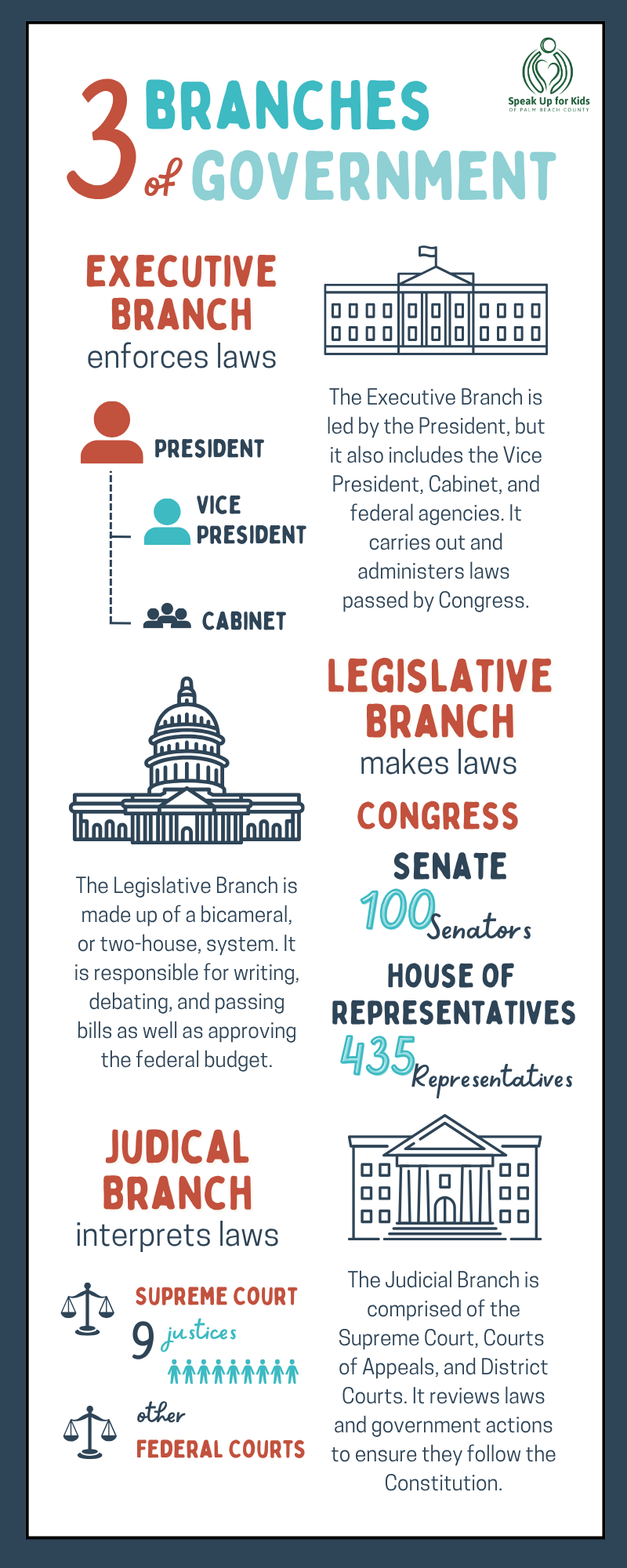
The main job of this branch is to make laws. This branch is mainly made up of the United States Congress, which has a bicameral (or two-house) legislature. These houses are the Senate and the House of Representatives, which work together to pass new laws.
The Senate and House of Representatives have similar functions but are unique in structure. The House has population-based representations, meaning that the number of representatives per state varies based on that state’s population. So, for example, Texas has quite a few more reps than New Jersey. These representatives have shorter terms and work to initiate revenue bills and impeachments. The Senate, on the other hand, has equal state representation (two per state). Senators have longer terms and work to confirm nominations, ratify treaties, and conduct impeachment trials.
The legislative branch is given certain powers in the Constitution alongside making laws: these include declaring war, overseeing the federal budget, and confirming presidential appointments (so the president can’t just hire anybody!).
The Executive Branch
The main job of this branch is to enforce laws. It is led by the United States President but also includes the Vice President, Cabinet (heads of 15 departments), and other agencies. This branch makes sure that federal laws are carried out daily through its network of departments.
The president is tasked not only with serving as the face of the country but also with being the commander-in-chief (the person in charge of military forces), negotiating treaties, and issuing executive orders. Executive orders allow the president to act quickly without needing Congress’s approval. The vice president doesn’t only serve as a step-in as president if needed; they also preside over the Senate.
The Judicial Branch
The main job of this branch is to interpret laws. What does this mean? Well, this branch contains all of our United States courts, ranging from the lowest-level District Courts to the higher-level Courts of Appeals and finally the highest court in the land, the Supreme Court. (Although, technically, the “highest court” is the basketball court located a floor above the Supreme Court's courtroom.)
In terms of interpreting laws, all of these levels of courts serve one goal: to decide the meaning of federal laws passed by Congress by hearing cases involving these laws. The judicial branch can also determine if laws violate the Constitution.
Cases move through the system by starting at the district level. If a party is not satisfied with the district court’s decision, they can appeal. If a court of appeals decides to hear the case, it is passed up the ladder. The Supreme Court, complete with 9 justices who serve for life, marks the final destination for a case to go (the top of the ladder). So, the Supreme Court holds the final judgment on a case; overturning a Supreme Court decision is a very difficult process.
Final Thoughts
While that all sounds great, the government does not work as three separate branches; these branches must work together to get things done. That’s where checks and balances come into play. Each of the three branches has certain powers to “check” the other two branches, ensuring no branch becomes too powerful or corrupt.
Now that you know the basics behind how each of the three branches of our government works, you can understand its structure as a whole much better. That’s one step closer to becoming an informed citizen! If you want to dive deeper into the inner workings of our government, check out this list of the exact checks and balances granted to each of its branches: https://bensguide.gpo.gov/j-check-balance