

Beyond the Ballot: How Presidents Really Get Elected
Contributed by Estella Lavrik — Speak Up for Kids Student Intern, a Jupiter High School student involved in student government and Music Buddies, who enjoys math, science, writing, and art, with a focus on building professional skills for her future career.
Overview
It may come as a surprise to you, but we don’t directly vote for our president! The presidential election process involves something known as the Electoral College: a group of electors that is formed every four years for the sole purpose of voting for the United States president.
But the Electoral College only represents the final step in the process for presidential candidates. In reality, the election process is a whole lot longer, starting at least a year before the main election takes place. This article will briefly cover each of the steps to becoming president in case you ever want to give it a shot. (But seriously, it’s important to know this process as a citizen of the United States! And since you want to be informed before beginning to vote yourself once you turn 18).
Requirements
Of course, becoming the President of the United States is not that easy. There are a few requirements in place that you must meet before running:
You must be a natural-born citizen of the United States.
You must be at least 35 years old.
You must have been a resident of the United States for at least 14 years.
If you clear all three, then you’re good to go!
Campaigning
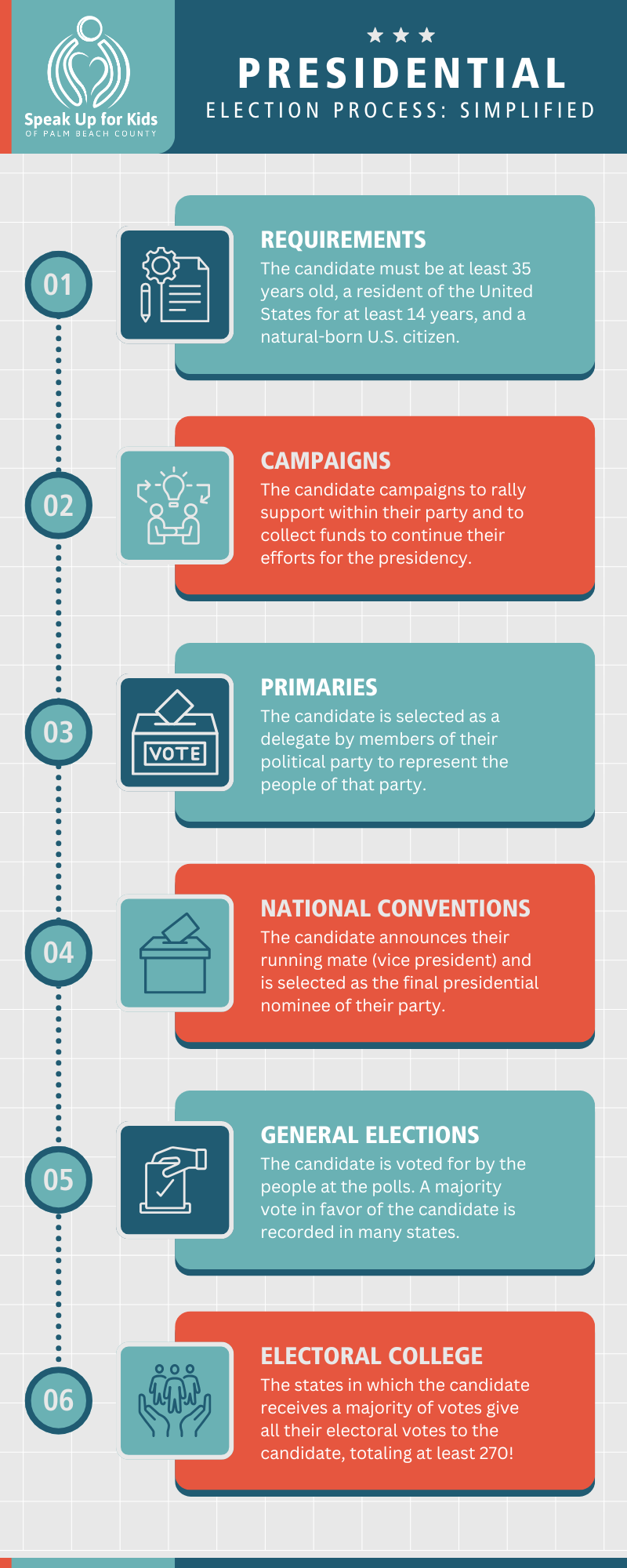
Candidates from the two main political parties, the Democrats and the Republicans, alongside candidates from third parties, begin campaigning at least a year before elections. This process involves setting up a team and touring the country to rally support and fundraise their campaigns. Eventually, candidates will participate in televised debates, during which they are asked questions about their policies and must defend their stance on issues against other candidates.
Primaries and Caucuses
Primaries and caucuses are typically held beginning in February. They allow members of each political party to select delegates who will represent the people at the upcoming conventions. Both of these votes can be “open,” “closed,” or somewhere in-between. “Open” means voters do not have to be registered with a political party to participate, while “closed” means only voters registered with that party can vote. While having similar functions, primaries and caucuses are a little different:
Primaries involve voters choosing their preferred candidate anonymously through secret ballots. The state in which a primary is held uses the results of the vote to award delegates to the winners.
Caucuses are meetings run by political parties, held at the county, district, or precinct level. Some choose candidates by secret ballot, while others divide participants into groups according to their desired candidate, with each group giving speeches to get others to join their group and vote in their favor.
National Conventions
National Conventions are held by each party to select a final presidential nominee, which is officially announced at the end of the conventions. The presidential candidate will also choose a running mate - the vice presidential candidate. At this time, campaigning becomes much larger-scale as candidates compete for the support of the general population.
General Election
In November, the people vote for their preferred president and their running mate at the polls. While it is true that the people are casting their own votes, they are actually voting for a group of people known as electors. In almost every state (with two exceptions), if a candidate receives the majority of the votes from the people of a state, then they receive all electoral votes of that state.
Electoral College
At this point, voting is finished (for the people, anyway). Electors now cast their votes, one each, to determine who will be president. The number of electors each state gets is based off of that state’s representation in Congress. More specifically, this number is equal to the combined number of that state’s Senators (2) and Representatives (equal to the number of Congressional districts), making up a total of 538 electors. So, the presidential candidate who gets more than half of the total votes, or at least 270, wins!
Final Thoughts
You may be thinking, Why do we use the Electoral College? Well, the answer is a little tricky; even the Electoral College itself is controversial. Read this short article discussing the debate around the election process to learn more.