
Taking Control Of Your Habits
Contributed by Speak Up for Kids Student Intern Team — This article was developed through the combined efforts of multiple student interns, each bringing unique skills and perspectives to support life skills education for foster youth.
Overview
When you wake up in the morning, what is the first thing that you do? For many of us, this might be checking our phones or hitting the snooze button one more time. While this may seem insignificant, the way you start your day can tell you a lot about the kinds of habits you’ve learned to adapt over the years.
Whether it is trying to stop bad behaviors or start good ones, habits play a huge role in our lives. At times, it may seem like building and breaking habits is something out of our control or simply up to our brains. However, if we understand how habits form, we can determine the best strategy to use this process to our advantage.
Understanding the Habit Loop
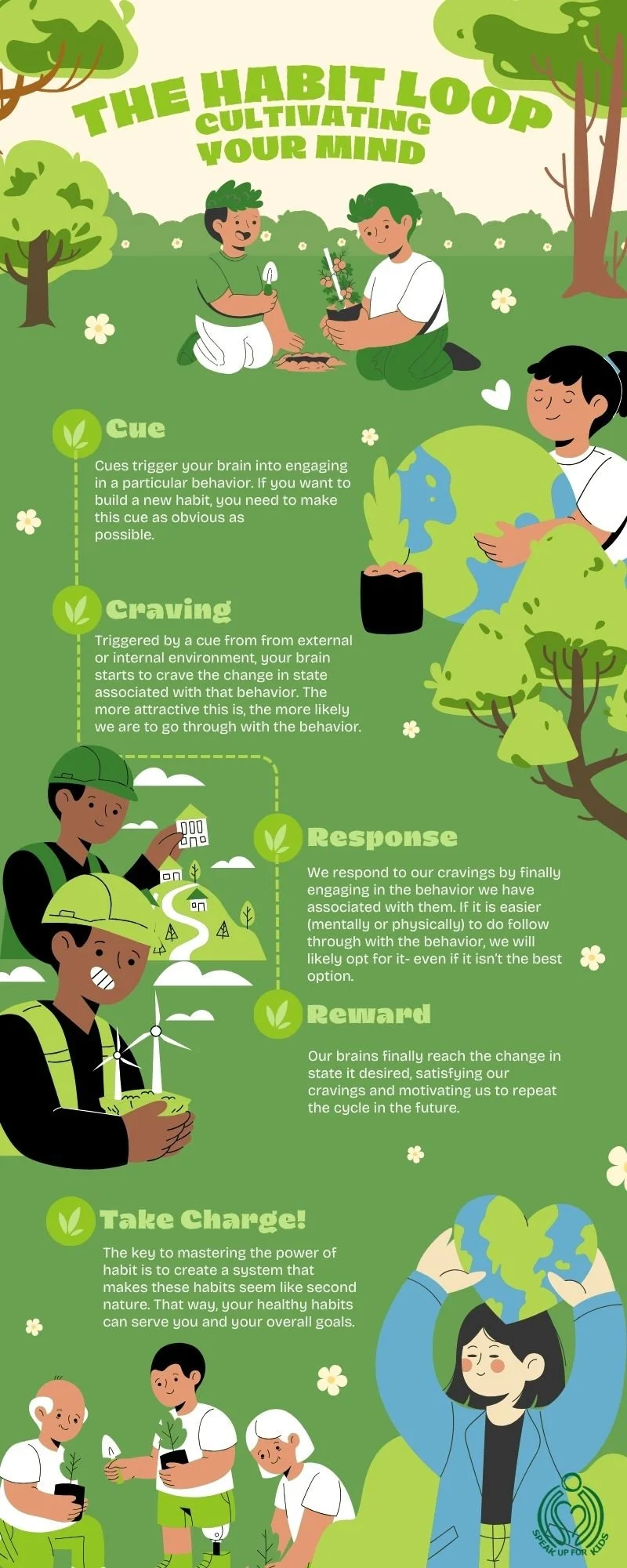
All habits occur in 4 different steps: cue, craving, response, and reward.
Cue- our brain is triggered by some kind of sensory information, causing it to predict a specific reward. When we wake up next to our phones, this might cue our brain to doomscroll for an hour or two before actually getting up.
Craving- because of this cue, our brain starts to desire the change in state provided by this activity. We don’t really want to check our phones as soon as we wake up; we want to be entertained or informed.
Response- in the face of these cravings, we finally succumb to our urge and engage in that particular activity. This can be an action (scrolling on Instagram) or even a thought.
Reward- this is the end goal of every habit. Rewards can be anything from a feeling of relief or even gaining approval from others.
Breaking the Loop
Now that we understand how habits form, we can hijack this cycle to satisfy our needs in a more healthy manner. The truth is, we seek rewards for two reasons: to satisfy and teach us. Reaching our end goal allows us to satisfy our cravings for a particular state (mental or physical), teaching our brain that we can replicate this response in the future to attain the same results. The key to building better habits is to create a healthier system that produces a very satisfying reward. That way, we can teach our brains to keep doing this activity in the future.
To do that, we’ll need to alter our habit loop:
Cue- make your cue almost annoyingly obvious so that it triggers your brain to act. Instead of keeping your phone at your bed-side table, maybe replace it with a journal.
Craving- make your new habit seem very attractive. If you are constantly craving entertainment when you wake up in the morning, try finding a book with an interesting plot to read.
Response- make the response to that craving easy. This may mean placing the materials required for it as close to you as possible. The harder it is to actually do the activity, the less likely it is for you to follow through.
Reward- make the reward super satisfying so that your brain is encouraged to promote that same activity in the future.
(Note: If you are trying to break a bad habit, just do the opposite of all of this. Make your cues invisible, your cravings unattractive, your response difficult, and your reward unsatisfying)
Final Thoughts
All in all, learning how to take control of your habits can be a difficult task, but it is important to stay determined. Even if it takes a while for them to stick, the rewards will always be worth it as long as you learn to master this never-ending cycle. Humans are creatures of habit, so let’s use these habits to chase a better life one step at a time.