

It's Never Your Fault: Navigating Sexual Assault
Contributed by Carlie Antoine — Speak Up for Kids Student Intern, a senior at Dreyfoos School of the Arts majoring in Strings, who enjoys art, drawing, crochet, reading, and exploring STEM subjects alongside music studies.
Overview
Sexual assault is the act of engaging in sexual violence with someone who has not consented. Many victims of sexual assault often experience feelings of confusion and even guilt, for it can be difficult to put into words just what happened to them. However, it is important to realize that it is never your fault and you are never overreacting- your feelings are valid.
Knowing how to identify behaviors that count as sexual assault can be tricky, so here are some things to look out for as you navigate these issues.
Inappropriate Behaviors
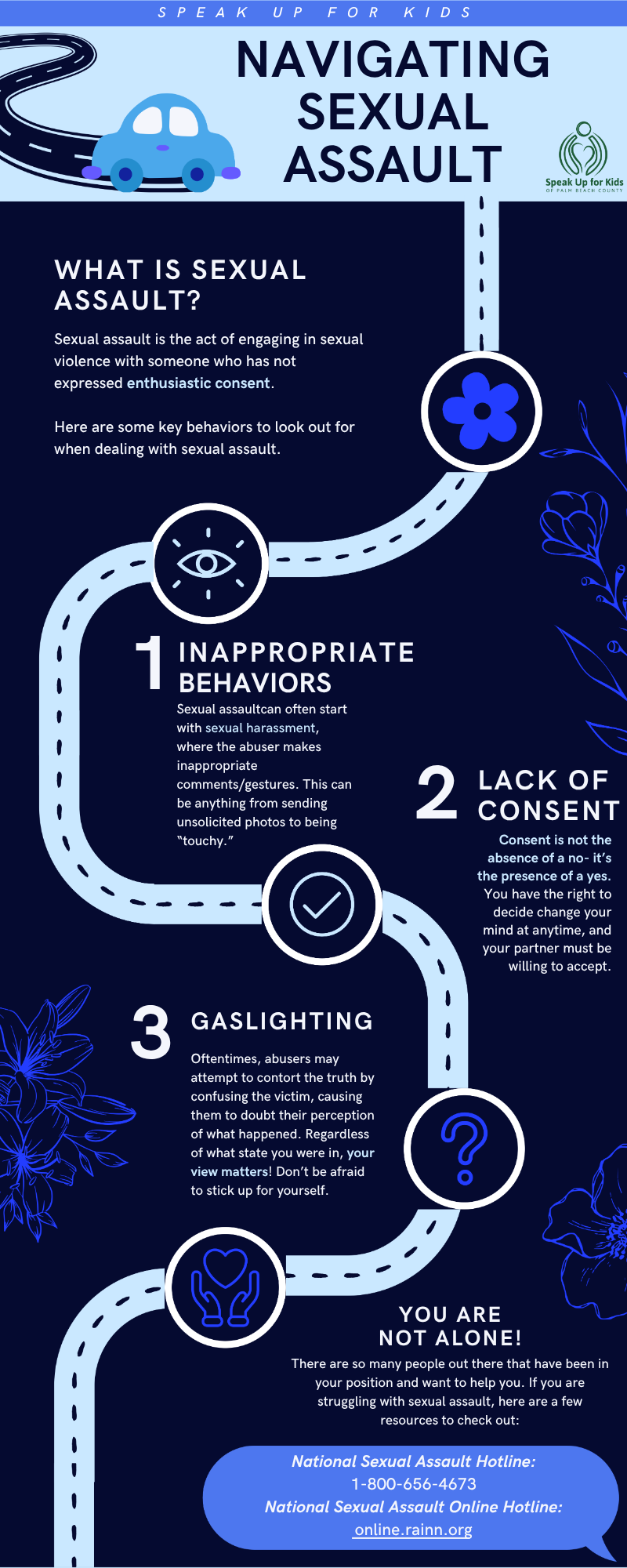
Oftentimes, abusers may engage in activities that cause their victims to question whether or not they were just sexually harassed. Sexual harassment is the act of making inappropriate comments and/or physical advances of a sexual nature. While it is often associated with the workplace, sexual harassment can happen in any context, whether that is in the classroom or at home.
Sexual harassment can seem difficult to call out at first, for it can be difficult to know if a particular action was “inappropriate” or even worth reporting. Still, sexual harassment includes any behaviors that you did not personally consent to. This may include:
Offering favors in exchange for sex
Sending unsolicited intimate pictures
Lack of boundaries and being very “touchy”
While calling out these behaviors may feel a bit intimidating, it is important to recognize these dangerous signs early before the situation starts to escalate further. Regardless of how that person is acting, it is important to remember that you have the right to feel safe in any environment. If these behaviors are making you feel otherwise, then it is time to reach out to someone you trust.
Lack of Consent
When you are engaging in sexual acts, it is important to realize that you have the right to remove your consent at any time. Consent is the act of giving your permission to engage in an activity, and it is the most important aspect of sex to consider. Sex is something that you should be able to control rather than simply letting your partner take the lead. The bottom line is this: consent is not the absence of a no, it’s the presence of a yes.
This also means that you have the right to remove consent at any time for any reason. You may have believed that you were ready for a certain activity, but realized halfway through that you weren’t up for it after all, and that’s okay. On the other hand, you could enthusiastically consent to one sexual activity but draw the line at another- and that’s okay too.
The key to understanding consent is knowing your personal boundaries. If someone tries to cross a line you have clearly drawn, it is sexual assault. Sex with enthusiastic consent should include:
Being of a legal age
Being in a sober state of mind without coercion or threats
Asking questions throughout to ensure that one’s partner is okay
Offering reassurance that they can stop at any time
Gaslighting
After experiencing something as traumatizing as sexual assault, it can be hard to process what just happened to you. This can become even more convoluted if the abuser is trying to “explain” your feelings for you and justify the event through gaslighting.
Gaslighting is the process of an abuser trying to confuse the victim and encourage them to question their perception or judgment about what happened. The goal is to make the victim feel like they were somehow at fault for what occurred, preventing them from properly defending themselves. Some of these lies include:
Claiming that you had “asked for it, not them.”
Taking advantage of the fact that you were not completely sober
However, no one is ever at fault for experiencing sexual abuse. Your consent is what is most important, and that cannot be given when you are not in the right state of mind. Regardless of what your abuser says, your perspective matters, so don’t hesitate to take the appropriate steps and get the help that you need.
Conclusion
Sexual assault can be a traumatizing experience for anyone, but it is important to remember that you are not alone throughout this entire process. You and your boundaries deserve to be treated with respect. If you feel that someone is crossing these lines, it is time to speak up and find a community that will take your concerns seriously.
If you are navigating a situation like this, here are some resources to look into:
National Sexual Assault Hotline: 1-800-656-4673
National Sexual Assault Online Hotline: online.rainn.org
Joyful Heart Foundation: https://www.joyfulheartfoundation.org