

The 5 Must-Do’s of Public Speaking
Contributed by Max Pour — Speak Up for Kids Student Intern, driven by a love for music and endurance sports, and committed to a future in communication and motivational speaking.
Overview
Public speaking isn’t just a skill you need for high school when you’re giving a presentation in history class. It’s something that can bite you at any point of your life, especially in a job interview. But, you can’t just be a natural. All these experiences make you stronger and eventually turn you into that speaker you always admired. There’s five critical steps to changing the power and effect of your voice, and after following them, you’ll be speaking at any chance you get. So what are they? Let’s dive into it.
Practice
Firstly, the most important of them all, is practice. If you don’t practice, it’ll be visible to your audience, which is the last message you want to send to a crowd. Instead of making it seem like it’s the first time you’re reading through your speech or giving your presentation, devote some time in advance to go through your speech alone in a quiet space. The absolute best place is in front of a mirror:
Place your paper or device with your presentation in front of you so it’s in front of your eyes, and use the mirror to your advantage.
Once you go through your speech more than five times, surely it’ll become tiring. But, who said it was easy? Because then everyone would do it.
The more practice beforehand, the easier it’ll be when the real show is set.
Gather Feedback
Practicing alone isn’t the only key to a successful presentation. After you’ve read through the speech multiple times, ask two or three people to listen as you can gain valuable feedback from them. It’s not smart if your audience member count goes from zero to fifty because then you’ll be the only person to judge your presentation before you must give it for the finale. But, if you slowly keep increasing the number of people who you practice in front of, the stress won’t even reach you before you must present one last time.
Eye Contact
Consistent eye contact comes next. Without looking at the audience, there seems to be a lack of engagement. It makes the crowd feel like you’re not even trying to make an effort and immediately they’ll turn their attention away from you. Now, it’s unrealistic to lock your eyes with every pair present in the room. That’s not the point. Just focusing on one person in every part of the room will show that you’re attempting to make a connection with the audience. When you look at them, they’ll look back at you and value what you have to express. And once you see a smile, or two, or three, you’ll feel greater than ever as you move along.
So, how do you specifically choose who to make eye contact with?
Before you begin your speech, scan the crowd for an individual from each section of the room who looks like their ears are open and ready to listen.
Once you do that, look up from your paper every few sentences at those individuals. You’ll be rewarded with the most interactive crowd!
Body Language
Your hand and body movement is another crucial aspect of public speaking. This is one of those parts of a presentation that proves that you practiced in advance, as it’s quite difficult to figure out how to move your body parts on the spot.
Movement allows the audience to dedicate their eyes and ears to the speaker and avoid zoning out, which is what occurs most often when they simply hear someone rambling on and on for more than five minutes.
Hand gestures allow the crowd to paint an accurate picture in their head of what message the speaker is trying to send throughout the room.
One of the easiest ways to show valid body language is to put up three fingers if you’re highlighting three key ideas at any time in the speech.
Or another specific example that may be relevant in a school environment, is if you’re campaigning on stage and presenting a speech to the students in your grade. As you say “I will listen to what each and every one of you have to share,” it’d be helpful to point to each section of the room with one of your fingers in the moment.
These gestures may seem small, but they make the audience feel included and more willing to keep their eyes on you!
Posture
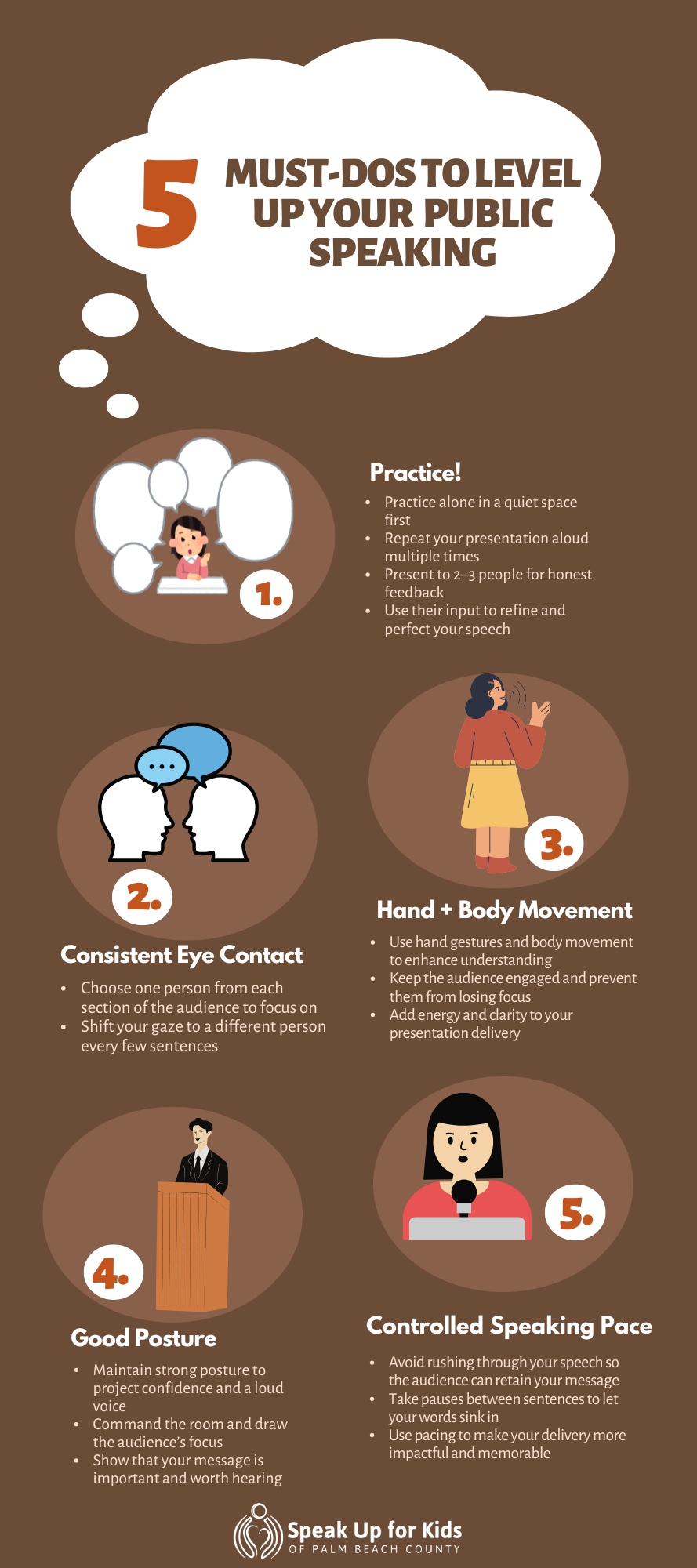
Now, don’t forget about posture. Posture is a part of life, and you must always try to stand straight with your shoulders pushed a bit back. But, when it comes to public speaking, this is a key part of your delivery.
Better posture equals a boost in confidence.
When you stand up straight as you present, you are showcasing a passion for the words coming out of your mouth, and it becomes so much easier to project your voice.
Standing tall allows you to make your voice clearer instead of slouching and seeming uninterested in what you have to share.
When you’re speaking, you want your presentation to be heard and assert power within the room, which is what good posture does for you. If you go with the other option and choose to keep your back bent, all you’ll see is a sleepy crowd in front of you that knows their speaker is uninterested!
Speak Comfortably
Lastly and certainly as critical as the others is finding a comfortable pace to speak at. When it comes to a speech, each one of your words needs to be both loud and able to be understood. If a person is going through their presentation in a flash, then no one in the crowd can identify one valuable piece of information or advice. On the other hand, if you go too slow, they’ll become bored and drowsy, leading them to not pay attention to the rest of your presentation. So how do you discover that right speed?
As you practice, take pauses between each sentence in a strategic manner. For example, if you’re planning to say a joke, then leave room for a longer crowd reaction before you jump to the next part. Or if you’re posing a question for the audience to think about, don’t be in such a rush to move on. Let their brains start moving for a bit, and then keep rolling.
Final Thoughts
It’s totally normal to be scared when you’re called to the front of class or are making a sale - those are just typical nerves! However, by practicing each of these aspects of public speaking over and over, you’ll eventually grow to love your voice. Rather than seeing your face be filled with redness, a smile will appear on your face when it’s your chance to present. Just always remember, it all depends on the amount of practice and planning you do in advance! You got this!