

Setting Boundaries for Yourself: Starting With "No"
Contributed by Speak Up for Kids Student Intern Team — This article was developed through the combined efforts of multiple student interns, each bringing unique skills and perspectives to support life skills education for foster youth.
Overview
This article will detail how to establish boundaries in three areas: self-care, workload, and relationships, as well as some ways to identify when boundaries have been crossed.
Self-Care
It's important to set boundaries for yourself as part of self-care. There are two primary ways to establish effective self-care: through mental and physical health practices.
Mental Health
There are several core components of forming proper mental health boundaries:
Self-Awareness – Try to pay attention to your thoughts and feelings
Be Kind-Hearted – Be compassionate to yourself
Determine Needs – Allow yourself to focus on what you need
Self-Awareness is the practice of understanding your own emotions and thoughts. This is an important skill to learn for the purposes of acknowledging your strengths and weaknesses.
Being kind-hearted to yourself means using a growth mindset to help you be more understanding and forgiving of yourself when things get tough. A growth mindset is one that encourages you to improve your position through effortful learning and perseverance. Say "no" to thoughts along the lines of "I can't do this" and say "yes" to the mentality of "I can't do this yet."
Determining your needs demands that you take time to self-reflect and focus on what you need to be successful. If you're having trouble with work, school, or other parts of your life, it may be time to take a step back and say "no" to those areas while you work on yourself first.
Physical Health
There are several core components of forming proper physical health boundaries:
Comfort – Make sure you're comfortable in the majority of environments
Health – Nutrition, sleep, exercise/hobbies
Consistency – Be effortful about maintaining your boundaries
Making sure that you're comfortable does not mean never going outside of your comfort zone. Rather, comfort in this context means surrounding yourself with people and going to places you can handle. Don't let someone talk you into going somewhere you don't want to go or doing something you don't want to do. If people attempt to violate your beliefs or values, say "no" when they try to cross those boundaries.
Health from a physiological perspective encompasses several areas. Nutrition is important for equipping your body with the resources it needs to fuel itself and enable your success. While you don't necessarily need to go on a diet, establishing good nutritional habits can keep you healthy throughout life. Getting on a consistent sleep schedule is important for rejuvenating your body and mind. Try to go to bed at roughly the same time each night, avoid making drastic changes to your sleep schedule, and incorporate any changes over the course of several days. Health also means engaging in activities that help you unwind and recharge. While exercise is one of the best ways to improve physical health, other hobbies that enable you to recollect yourself include reading, writing, and spending time with others.
Consistency refers to being intentional about following your routine even when you're feeling fatigued or stressed. It is in those moments where it's hardest to continue, but also most important to persevere! If you break one of your established boundaries, work to identify why that happened and prevent it from happening again in the future.
Know How Much to Take On
Whether in the context of school, work, or relationships, determining what and how much to take on in life requires an understanding of the following:
Goal Setting – Make your goals realistic and attainable
"No" is OK – Don't needlessly overexert yourself
Strike a Balance – Find stability between the different aspects of your life
Goal setting means making goals that align with what you hope to achieve in the different areas of your life. Be specific about what your goal is and how you'll achieve it. For example, "I want to become a better musician" is a poor goal because it's too general and offers no intentional path forward. "I will become a better musician by applying to X school and by taking piano lessons at the studio down the street" is much more specific and offers a more direct path for achieving the goal.
Saying "no" is an appropriate response when something would interfere with your current workload and responsibilities, when something violates established boundaries or your values, when you do not currently have the skills to fully realize the outcome, or when it negatively impacts your mental or physical health.
Striking a balance means forming an equilibrium between your responsibilities and goals regarding your personal, social, work, and school life. If you devote too much attention to one area, your progress in others may fall behind and cause you unintentional stress and strain.
Identifying Poor Relationships
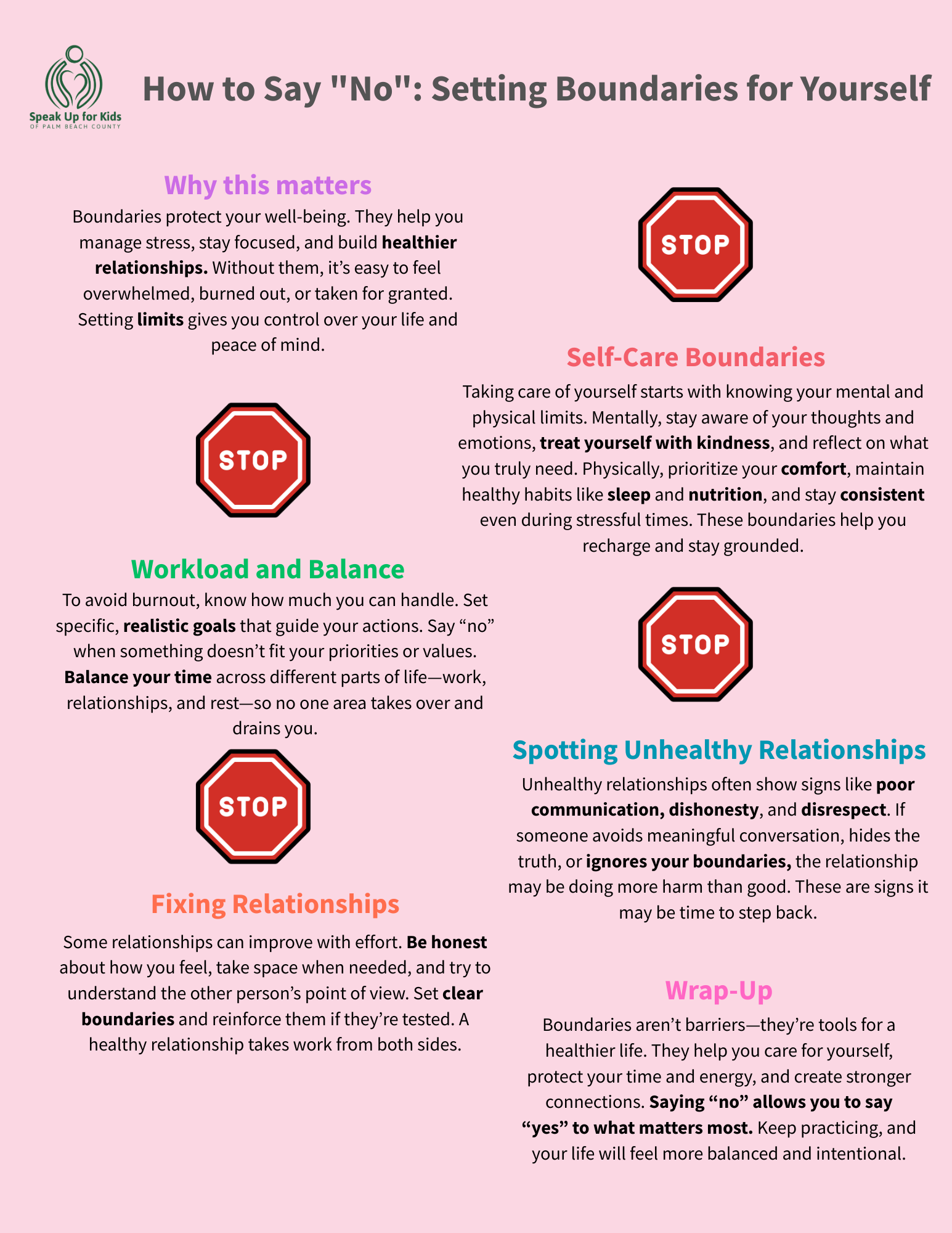
There are several components of a poor relationship, whether professional, friendly, or romantic in nature. Relationships should be founded on a basis of trust, empathy, and investment. Sometimes, however, a line is crossed, and a relationship can do us more harm than good. Here are some of the main factors you can use to identify an unhealthy relationship and the things you need to say "no" to:
Poor Communication – An inability or unwillingness to talk things through
Dishonesty – Being lied to or having the truth obscured or altered
Disrespect – Not having your position, beliefs, or desires heard, or being belittled
Poor communication is characterized by not actively listening and frequent interrupting. Another important component is stonewalling, which is when someone refuses to answer questions, contribute to a conversation, or withdraws entirely, creating a "wall" that makes progress toward improving a relationship much more difficult.
Dishonesty is characterized by defensive reactions to questions and an unwillingness to give straightforward responses. Secrecy can also be indicative of a lack of transparency. One of the largest indicators of dishonesty is outright lying, repeatedly not telling the truth, and showing little or no remorse when found out.
Disrespect is characterized by someone ignoring boundaries and failing to consider your feelings. Interrupting when you are speaking, criticizing, and failing to offer support are all signs of a lack of respect in a relationship.
A relationship is a two-way street; both sides must be willing to work toward a better relationship. If you see these signs repeatedly with no sign of effortful improvement, it may indicate that someone is only interested in what you can do for them and not what they can do for you.
Improving Relationships
If someone in your life doesn't lift you, doesn't provide encouragement, or is even hostile toward you, then it might be time to say "no" to the repeated violations and consider ending the relationship. There are, however, some ways to improve a worsening relationship:
Transparency – Be honest and make your feelings known
Distance – Take some time away from the person or people to let tensions cool down
Understanding – Consider the other person's point of view
Establish Boundaries – Give specific "dos" and "don'ts" and make sure they're understood
Transparency is the first and one of the most important steps to rebuilding a relationship when things go south, as to be clear is to be kind. Share your feelings and thoughts with each other and try to foster an environment where both parties are comfortable being honest with one another.
Distance is an important skill to develop when dealing with hardships in a relationship. When tensions begin to rise, take a moment to step away from the situation and recenter yourself so that neither side risks saying something they might regret later out of anger. This concept can also be summarized through the phrase "letting cooler heads prevail."
Understanding stems from developing a strong sense of empathy, the ability to put yourself in someone else's shoes. Both sides should take the other's wants into account and work together to reach a compromise or agreement about how to achieve a mutually desirable outcome.
Establishing boundaries requires you to clearly and specifically state what is acceptable and what is unacceptable. Keep in mind that boundaries may need reinforcing if they are under threat of being violated, and you may even need to establish new boundaries as a relationship progresses.
Final Thoughts
Saying "no" and establishing boundaries takes time and effort to improve at. In summary, here are the components of effective boundary setting:
Self-Care covers Mental Health, the components of which are Self-Awareness, Kind-Heartedness, and recognizing your Needs, as well as Physical Health in regard to Comfort, Health, and Consistency.
Knowing How Much to Take On asks you to consider Goal Setting, saying "No," and finding Balance among the different parts of your life.
Some of the main ways to identify Poor Relationships are through Poor Communication, Dishonesty, and Disrespect.
Some effective ways to Improve Relationships include Transparency, Distance, Understanding, and Establishing Boundaries.